



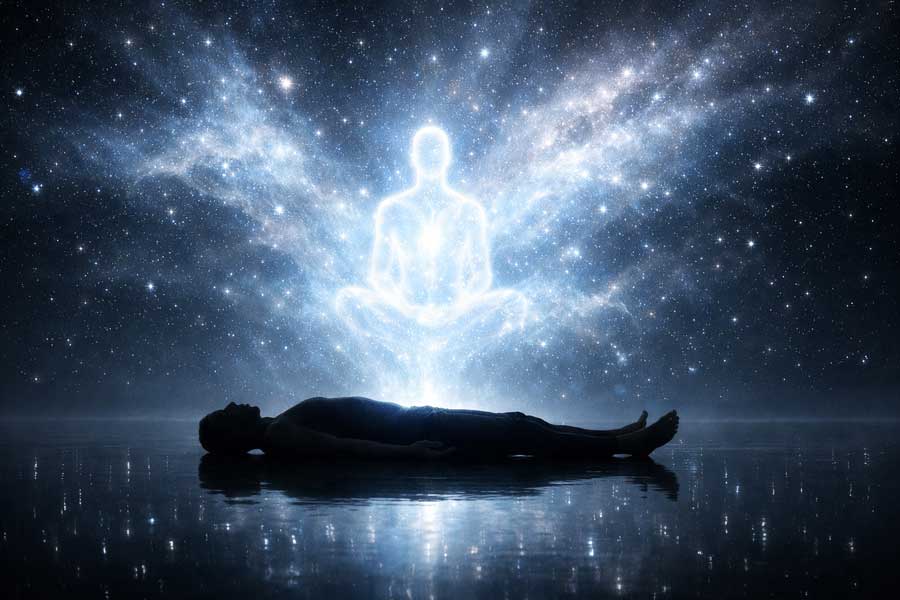
We are all human beings, and we have a body. However, we are not the body; we are not the mind, the intellect, or the emotions. All of these belong to us, yet we are not any of them. Our true nature exists beyond all bodies. Our true essence is beyond change and suffering, beyond time and space. Still, we have a body, and through it we travel the world and experience life.
Our body needs rest, and our mind needs rest. Every night we go to sleep to restore our energy and reboot our inner computer. Yet sometimes fifteen minutes are enough for full recovery, while at other times even an entire night is not. Why does this happen?
We ourselves never become tired. The body becomes tired, the mind becomes tired—but we do not. When we identify ourselves with the body or the mind, fatigue appears, and sleep comes, taking us to a state where the body is no longer felt. And when exhaustion becomes extreme—when the soul grows weary of being identified with the body—another kind of sleep arises, much deeper. In that state, the connection with the body is completely switched off, unlike in ordinary dreaming sleep.
Shavasana, in Sanskrit, means corpse pose. An effective Shavasana is one in which the practitioner, while resting in this most powerful yogic posture, resembles a dead person. Yet this resemblance must be not only external, but internal as well. In Shavasana, one must separate oneself not only from the physical body, but also from the subtler layers of one’s nature. And if Shavasana is sufficiently successful—if separation from the mind occurs—samadhi is attained.
We are not the body. We are not the emotions. We are not the intellect. We are not the mind. Shavasana is total relaxation, but not death. In Shavasana, one must neither fall asleep nor die. If we manage to enter deep Shavasana even for five minutes, the restoration is so profound that it may feel as though we have been reborn. Why, then, does ordinary sleep not provide such deep renewal?
There are four states of consciousness: jagrat (wakeful activity), swapna (dream sleep), sushupti (deep sleep without dreams), and turiya (the state beyond dreamless sleep).
Jagrat is the state of activity in which the senses are directed toward external objects. Swapna is the state in which perception turns inward—we no longer feel the physical body, yet remain connected to subtler bodies. Only in sushupti does disconnection from both physical and subtle bodies occur. Thus, even five minutes in sushupti brings deep rest and recovery. If one goes further, into turiya, complete separation from that which is not the true Self becomes possible. In turiya, Shavasana becomes total.
Turiya is victory over death, for we are neither the body nor the mind—and therefore there is nothing in us that can die. Shavasana not only provides profound restoration, but may also become a doorway to samadhi.
Performance Technique
In truth, Shavasana has no technique, because Shavasana is the absence of body and mind—and therefore the absence of technique. True Shavasana begins where all techniques end. Still, some guidance may be offered.
1. Physical relaxation
Lie down on a flat surface. Let the arms and legs rest naturally apart, palms facing upward. The body is completely relaxed. At this stage, the aim is to make the body as inactive, calm, and silent as possible. There are many ways to achieve this, but all lead to the same result—the shutting down of bodily activity.
Some imagine bodily activity as lights that are gradually switched off. Others visualize tension leaving the arms, legs, chest, and head with each exhalation. You may choose any method that feels natural to you. What matters is that it is yours. Even imagining that the body has completely died can be effective. The key is intention: the body responds to sankalpa.
2. Mental relaxation
Once the body has become quiet and still, one may proceed further. Become the observer. Observe the breath without altering it—neither speeding it up nor slowing it down. Allow the body to breathe as it wishes, without interference.
Breath is closely connected with emotion and mind. By observing the breath, separation naturally occurs: there is breath, there is body, there are emotions, there are thoughts—and there is the one who observes them all. If images or visions arise, ignore them. Do not follow them, push them away, or invite them. Without receiving energy through attraction or aversion, they will dissolve on their own.
At this stage, deep relaxation and valuable experiential insight may arise. Yet for Shavasana to become complete, one must go further still.
3. Spiritual relaxation
Everything we are connected to appears as a part of ourselves: family, work, relationships, country, gender, passions, preferences, interests, enemies, creativity—the list is endless. For Shavasana to be complete, we must separate ourselves from everything we believe ourselves to be. We must also separate ourselves from the surrounding world. During Shavasana, we must become no one and nothing. Only then can the mind be transcended. There is the true Self, and there is the idea of the Self. The screen of consciousness must be free of all notions of identity. The final obstacle—the last veil of maya—is the sense of personal identity itself. This sense creates separation, giving rise to “I” and “you.” When even this is transcended, entry into the fourth state—turiya—becomes possible. Turiya lies beyond the mind, beyond duality. It cannot be described. It is pure, unobscured consciousness: Sat–Chit–Ananda.
Such spiritual relaxation is achieved through the power of intention, through sankalpa. One never returns empty-handed from turiya. All fears, problems, conflicts, and situations in your life will find their resolution, because they are created by the mind—and we are not the mind; we are beyond it. One comes to understand life, existence, happiness, right action, and non-action. Action then flows from the center of the soul.
Effects
Shavasana releases blocks and tension and has healing potential. It provides profound restoration. With regular practice, a person becomes more natural and authentic. Hidden abilities and talents may awaken; memory and cognitive clarity improve. Even certain chronic conditions may gradually dissolve.