



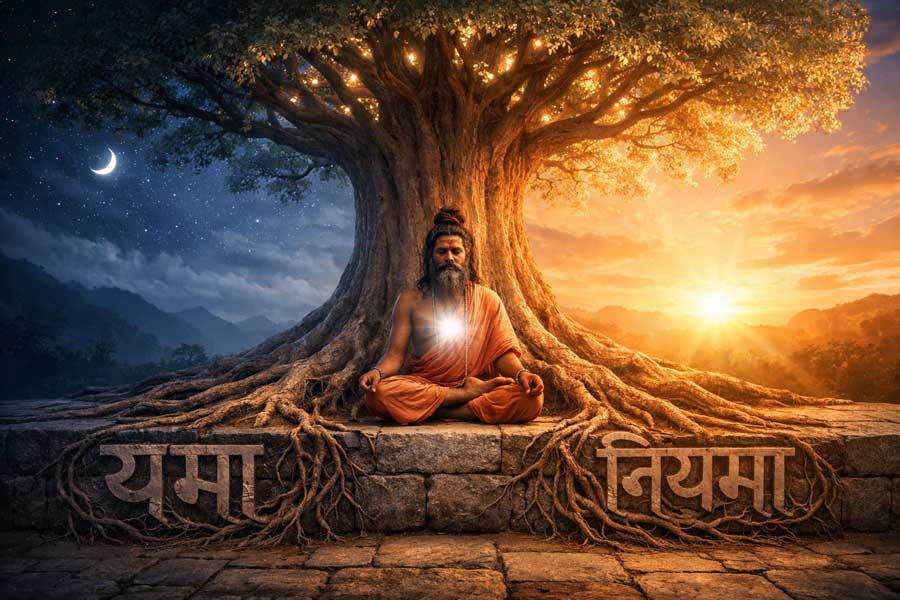
YAMA (death)
Yama represents the restraints that concern our actions and certain activities of the mind.
- Ahimsa (non-violence). Ahimsa means non-killing, or non-violence. This first and very important principle applies not only to physical harm or the killing of any living being, but also to thoughts of harm and the sending of negative vibrations toward any form of life. The observance of ahimsa grants great inner strength. When ahimsa becomes perfected, it acts like a shield against negative external influences. The power of ahimsa can protect us from unforeseen misfortune, negative emotions, and foreign vibrations. By cultivating ahimsa—by restraining violent imagination and uncontrolled emotions—the mind becomes powerful and capable of fulfilling intentions, for no one can harm a person who has conquered destructive inner tendencies.
- Satya (truthfulness). When the mind is revealed, it ceases to lie. First and foremost, one must stop lying to oneself. People often live in illusions and self-created falsehoods, and the words of such a person carry no real power. When a person stops lying to themselves, life changes radically. In a truthful person, the power of speech and thought increases; their sankalpa becomes extraordinarily strong, and whatever such a person speaks tends to manifest.
- Asteya (non-stealing). Asteya does not apply only to the appropriation of another’s property or belongings. It extends much further and concerns everything that surrounds us. People often take what does not belong to them without even realizing it. Humanity thoughtlessly exploits nature for personal gain and the triumph of the ego. Asteya is contentment with what we truly need and what life provides—not what the insatiable human mind desires. This principle applies not only to material things. Emotional hunger often drives a person in love toward inappropriate behavior, constantly demanding something from the object of their attachment. A person who is inwardly fulfilled does not ask or demand; therefore, everything necessary comes to them naturally.
- Brahmacharya (restraint). Great energy comes from exercising restraint in your emotions and sexual behavior. And this rule primarily concerns mental control and control of one's fantasies and imagination. Chastity makes us like children, and all ways are open to children, and then everything is possible. Sankalpa (thought power) and vikalpa (imagination power) are incredibly powerful in one who controls his passions. It is not possible to get happiness in the turbulent flow of uncontrolled passions.
- Aparigraha (non-possessiveness). Fear drives a person toward excess, yet in truth we own nothing—not even our own body. To inhale, one must first exhale. If we do not let go, nothing new can come to us. Those who have released everything possess the whole world, because they remain open to everything. When you learn to let go, you also learn how to receive. Often people cling to what they no longer need. Exhale—and the inhale will come naturally. Exhale—and life will come; love will come.
Niyama (rebirth, resurrection)
Niyama refers to what must be cultivated and consciously developed within oneself.
Pain and joy, victory and defeat, gain and loss—these pairs of opposites accompany us, shaking our entire being. Lust and desire bind us to a closed cycle. Christian teachings speak of sin as the root of all suffering, with confession and repentance as the remedy. Many people go to confession, yet their sins do not diminish. By identifying oneself as a sinner, a confessor attempts to overcome sinfulness, yet this is like trying to lift the stick on which one is standing—one can easily imagine how successful that is. True transformation requires stepping aside: envisioning oneself as righteous and becoming so. Confession serves to cleanse the channels through which divine grace flows during communion—through wine as blood and bread as body—restoring our true nature as Children of God.
- Shaucha (purity). Just as a good housekeeper maintains cleanliness in the home, so must a yogi observe purity in relation to all aspects of being. Each day we cleanse the physical body from outer and inner impurities, and our subtler nature requires similar care. There is informational pollution as well—ideas and thoughts from countless sources attempt to invade and seize our attention. By maintaining bodily cleanliness, we protect ourselves from bacteria and viruses. By maintaining mental purity, we protect our subtle nature and our life from foreign thought-forms. Living a life that is not truly one’s own is dangerous.
- Santosha (contentment). Contentment is characteristic of spiritually mature beings. Some people are constantly dissatisfied—with the weather, work, neighbors, authorities, and even themselves. When a person is content, happiness arises naturally. Everyone longs for happiness, for the divine nature is Ananda—bliss. God is complete and self-sufficient; bliss radiates from Him because He lacks nothing. Humans also seek fullness, but often attempt to realize it through external accumulation. Their actions manifest as uncontrolled and frantic amassing of money, material possessions, power, and fame—all as a way to feel that inner completeness. But true fulfillment is an inner state and can only be satisfied from within. Saints, possessing very little, embodied deep contentment and bliss. “Seek first the Kingdom of God, and all else shall be added,” Christ taught. He also said that the Kingdom of God is within us. Those who realized this truth were and remain true rulers of the world—their wealth and power are complete. Joy attracts joy; love attracts love. If you cultivate contentment, you will naturally attract everything you need. Avoid the company of people who constantly display dissatisfaction, and instead seek contact with those who can bring positivity into your life.
- Tapas (asceticism, heat). The word tapas comes from the root tap—to burn. Tapas exists in everything. The energy of tapas allows a hen to hatch a chick from an egg. The energy of tapas allows what is intended to be brought into manifestation. Any practice can become tapas. The fire of tapas can transform our entire nature. Tapas arises through regular practice and deep concentration. When the inward-directed mind ignites the subtle fires of tapas, the movement of unidirectional energies begins. The power of thought and imagination increases and can develop into the capacity to accomplish extraordinary things. When this Power is directed toward the center, toward the soul, it can reveal our divinity and lead to immortality.
- Svadhyaya (self-knowledge). The word that defines this concept is usually translated as “study.” However, the word sva means “one’s own,” and therefore svadhyaya means self-study, or the study and knowledge of one’s own Self. One may study sacred scriptures and, in this way, come closer to understanding, yet the scriptures themselves do not contain absolute Truth. Only the knowledge of Oneself can lead to truth and to Truth. By knowing Ourselves, we come to know our Own Divinity and the Divinity of All that surrounds us.
- Ishvara pranidhana (devotion to the Lord). Ishvara means “Lord” in Sanskrit. Water in a bucket cannot be the ocean. But when a bucket of water is immersed in the ocean, the water in the bucket becomes the ocean. When we are immersed in the Lord (Ishvara), we become the Ocean. We are the Ocean—this must be remembered. The primary goal of yoga is attained when the mind is directed toward the Higher Goal.