



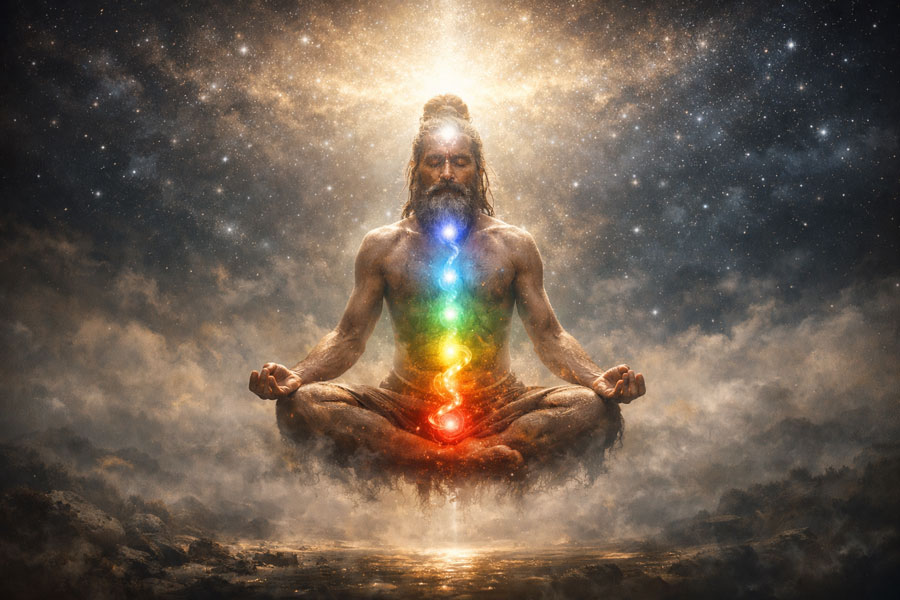
Imagination becomes reality. Possibilities are born from imagination. Love is immensely powerful. It compels the Formless to take form and fearlessly endows God with desire. Work diligently, and you will attain success. The darkness of life will disappear. Where there is effort, blessings descend. To receive the blessings of God and the Guru, one must pass through difficult practices. Progress on Earth is very rapid, while in other worlds it is greatly slowed.
1st Body
Muladhara Chakra. Earth. Annamaya Kosha. Sthula Deha. Physical body.
2nd Body
Svadhisthana Chakra. Water. Pranamaya Kosha. Sukshma Deha.
The etheric or celestial body, the body of emotions.
3rd Body
Manipura Chakra. Fire. Manomaya Kosha. Astral body. Sukshma Sharira. Intellect.
The science of prana; a battlefield of energy, mind, and knowledge; the fiery body; the fire of intellect and logic; the transitional point from the outer to the inner; thinking itself. Experience develops here that transcends emotions. Yet this body arrives together with samskaras accumulated over millions of lifetimes. Prarabdha karma and memories of previous incarnations may surface. Vicharas (thought-forms) become activated, and ahamkara creates individuality.
4th Body
Anahata Chakra. Air. Vijnanamaya Kosha. Manasa Deha. Sukshma Sharira.
The body of the psychic mind. The mind itself.
This body is connected with hypnosis, telepathy, magic, and similar phenomena; with understanding the motives of others and reading thoughts. Time cannot stop it. It can express thoughts without words. It can shape a person into anything. It can travel outside the physical body. Its possibilities are endless; its activity unfolds in the subtle world, and it has no boundaries. The world of this body arises directly from the soul — it is the soul’s subjective manifestation.
From this body begins the field of illusion and deception, because the principles of the material body collapse here. The foundations of the fourth body’s world are not objects of the ordinary world — it is entirely subjective. What happens in the fourth body cannot be verified.
Siddhis. The soul pulls upward, while this body keeps one within the limits of the manasa sharira. This body influences the three lower bodies and can develop them. Processes occurring in the manasa deha (the fourth body) may be purely imaginary, yet they genuinely have their place. Whatever siddhis may manifest, they are all gifts of the fourth body. But this is the most dangerous realm — it enchants and creates traps.
One who does not possess the body of mind (the fourth body) is not truly human. One must learn how to use this body. The mind is the charioteer of the ten senses, but not their master — it is merely an instrument. The mind must be made yogic, and Kundalini must be freed from its influence. The body of mind must pass through practice and discipline. This is not a path of righteousness or sin, but a path of divinity and fearlessness.
The mind is an immense applied center — the most useful thing in the world. When the mind is revealed, it does not lie. It becomes false only when it attempts to dominate the senses and become their master. Observe yourself; look from the outside — at your body, your movements, your state during activity. When you become a simple witness, you will easily find the location of your own mind. Properly applied imagination is a science — a gift of the fourth body. Power resides within the body of mind and is connected to the material world. When the fourth body is fully developed, a person becomes free from siddhis.
5th Body
Vishuddha Chakra. Akasha (Space). Anandamaya Kosha. Atmika Deha. Karana Sharira.
The body of the soul. Aditya Loka (the Solar World).
It is millions of years old. Through the power of sankalpa, Kundalini is raised from the fourth body and enters the fifth — the body of the soul. All self-definition resides in the fourth body, while the fifth is the complete, unabridged version of the fourth — yet it is not psychic and contains no desires. In the fifth body, no knowledge is needed anymore. No learning or science can enter the fifth body — one must rise above all of humanity. The first four bodies can be developed through worldly knowledge and its application, while the fifth body may be called a condensed essence. Beyond the fifth body remains only the Divine Substance — the eighth stage of yoga.
6th Body
Ajna Chakra. No element. The Body of Brahman. Brahma Sharira. Cosmic body.
At this level, everything is immersed in Brahman; ahamkara (ego) is absent. In the sixth body, one may encounter the Higher Soul. Here there is as yet neither freedom nor dependence. Everything merges into one — realization and awareness. “Aham Brahmasmi” — “I am Brahman” — is the hymn of the sixth body.
Only a small part of the brain is active here; the greater part awaits awakening. The center within the brain is divine. It is called the third eye — a supranatural organ. Once it opens, the meaning of life can be understood and the mystery resolved.
7th Body
Sahasrara Chakra. No element. Mukta Deha. The body of Nirvana. Beyond everything.
Seven bodies — seven chakras. Everything is sealed within three bodies: physical, subtle, and astral. The soul is covered by the causal body (karana sharira); the astral body (sukshma sharira) is an extension of the physical body. It is active because the astral body is Chitta, and the radiance of Atma is reflected within Chitta.
Hridaya Purusha is located in the Brahmarandhra (an opening in the region of the head), the size of a thumb. Above it is the Sahasrara Chakra. Beyond it lies Chidakasha — the space of consciousness. Chidakasha is the abode of Chitta, the astral body, upon which the rays of Atmic consciousness shine. When manas and prana reach Chidakasha, they are absorbed into samadhi, as all activity ceases. This is the stopping point of all vrittis — the waves and vibrations of mind and matter.
Four States of Consciousness
1. Jagrat (waking state).
The world is perceived through the five senses, primarily through the eyes; therefore, the jivatma resides in the eyes during jagrat.
2. Svapna (dream state).
In svapna, the jiva resides in the neck, and everything from jagrat passes into subtle form through the hitta channel near the throat center. All experiences of svapna arise from the throat.
3. Sushupti (deep sleep without dreams).
In sushupti, the soul abides in the heart region — hridaya pradesha. Vital activity originates from the heart; when the heart stops, the body ceases to move. The heart center is the place of samadhi for the body, the senses, and action.
4. Turiya (the state beyond dreamless sleep — true awakening).
The mind requires rest. Turiya is samadhi — rest for the mind. The samadhi of the mind is realization of one’s own essence. Samadhi is a journey into the light where there is no duality or doubt.
The soul looks through the eyes. In samprajnata samadhi (samadhi with mind), the jivatma abides in the Ajna Chakra — the center of divine vision and Shiva’s third eye. In asamprajnata samadhi (samadhi without mind), the jivatma abides in the Brahmarandhra.
Consciousness is Purusha. Consciousness now divides into awareness of pure, attribute-less Brahman (the consciousness of the Universe) and the consciousness connected with the body — pinda sharira. Pinda sharira further divides into pure form — Atma — and jivatma.
Awakening of Kundalini
Prana plays a crucial role in the awakening of Kundalini. Yogis must intensively practice pranayama. There are many pranayamas for raising Kundalini. The body and the mind are instruments; the bridge is breath and life. One must prepare to leave body and mind behind — to move from certainty to uncertainty, from wisdom to the absence of wisdom. When the unknowable is realized, one encounters one’s true essence. For this, one must leap into the transcendental.
After the transcendental leap, we land where we truly are — this is objective reality and the felt sense of Being.
Samadhi is a leap and a halt in emptiness — in the great emptiness where movement and life cease. This emptiness is not absence, but the source from which everything arises. There, life neither moves outward nor inward — there is balance. For this, a simultaneous leap of mind and body is required. The mind fears this leap into emptiness because it loses its power. In emptiness, true realization dawns.
SAMADHI IS THE WAY, THE TRUTH, AND THE LIFE.
From the book Pilot Babaji Kundalini