


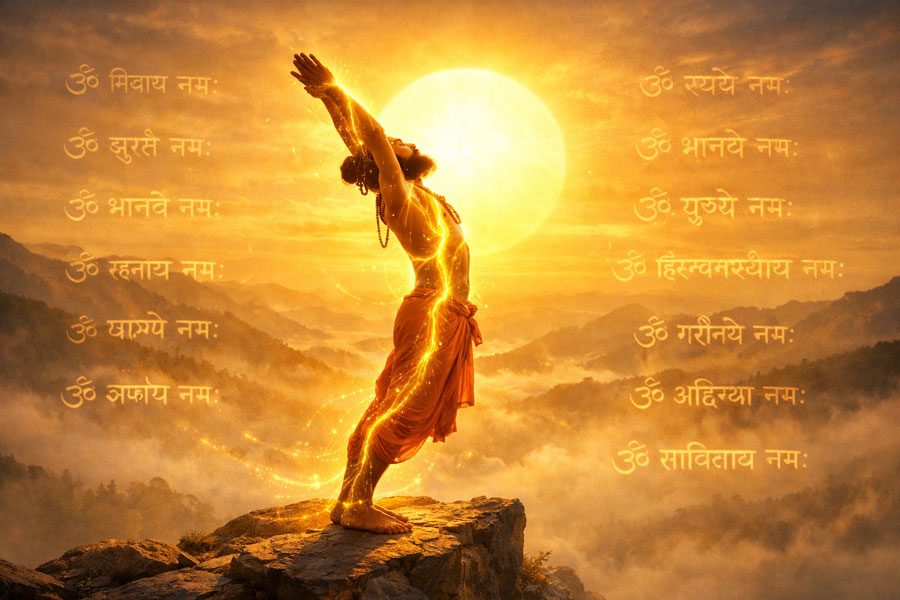
Surya Namaskar means a salutation or worship of the Sun. This yogic practice arose through observing the behavior of animals—especially the way cats stretch after awakening from sleep. Surya Namaskar is performed in synchronization with inhalation and exhalation. It is also important, while performing this practice, to visualize the movement of prana within the body: with inhalation, prana enters us, and with exhalation, it spreads throughout the entire body.
All movements should be performed until a mild pain is felt—similar to the sensation experienced while stretching after sleep. This sensation is a sign of vitality and health. The speed of execution, the number of repetitions, and other details of the practice are individual and are revealed through regular practice. It is recommended to perform Surya Namaskar 12 times—6 times on each leg. These correspond to the 12 names of the Sun, the source of all life on Earth.
The 12 Sun Mantras
Om Mitraya Namaha
Om Ravaye Namaha
Om Suryaya Namaha
Om Bhanave Namaha
Om Khagaya Namaha
Om Pushne Namaha
Om Hiranyagarbhaya Namaha
Om Marichaye Namaha
Om Adityaye Namaha
Om Savitre Namaha
Om Arkaya Namaha
Om Bhaskaraya Namaha
Technique of Practice
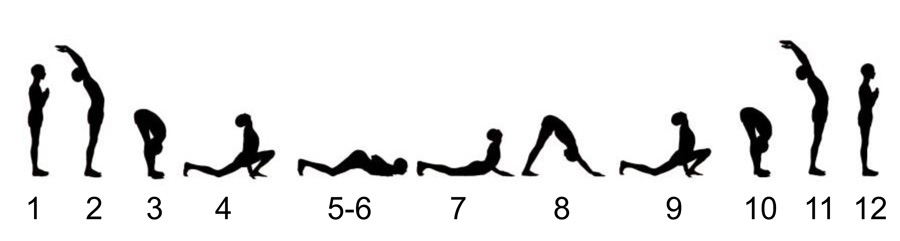
- Stand upright. Bring the palms together in front of the chest, as in prayer. The gaze is directed forward, as if looking at the Sun. Exhale. (Photo 1)
- Inhaling, stretch upward and bend backward, raising the arms overhead and slightly behind the head. Keep the elbows and knees straight; do not separate the palms. (Photo 2)
- Exhale and bend forward, reaching the hands toward the feet. Try not to bend the knees. Let the head and shoulders relax downward. (Photo 3)
- Step the right leg far back and inhale. Place the hands on the mat on either side of the left foot. The left knee is bent, with the shin perpendicular to the ground. The gaze is directed forward. (Photo 4)
- Exhale and step the left leg back to meet the right. The head, torso, and legs form a straight line, almost parallel to the ground, supported by straight arms with palms on the mat. (Photo 5)
Immediately afterward, lower the knees and arch the back, bringing the pelvis back and downward toward the heels. The palms remain on the mat. (Photo 6) - Move the torso forward, almost touching the mat. Form the posture in which eight points touch the mat: two feet, two knees, two hands, chest, and chin. Then, inhaling, move forward into the Cobra Pose. (Photo 7)
- Next, lift the pelvis upward while inhaling. Keep the palms and feet firmly on the mat. The body forms a triangle, with the hips as the apex, and the legs and torso—with arms straight at the elbows—forming the sides. Gently arch the spine. (Photo 8)
- From the triangular position, move the torso forward and step the right foot between the hands, as in step 4, but with the opposite leg. Inhale. (Photo 9)
- Step the left foot forward to meet the right, inhaling. Keep the hands on the mat and the torso folded forward, as in step 3. (Photo 10)
- Inhaling, raise the torso and arms upward, then gently bend backward as in step 2. (Photo 11)
- Exhale and return to the initial standing position with palms together. (Photo 12)
- This completes one cycle of Surya Namaskar. The next cycle may begin with the left leg, repeating the same sequence on the opposite side. It is recommended to perform 12 cycles in total (6 on each leg). One of the names of the Sun may be recited with each cycle. The 12 names (or forms) of the Sun correspond to 12 completed Surya Namaskars.
Benefits: By practicing Surya Namaskar regularly, we maintain the body in excellent condition. All the major joints and the spine are engaged in this practice, and flexibility develops naturally. The body becomes enriched with oxygen and prana. If you do not have time to practice other asanas, Surya Namaskar alone can serve as a complete practice. Much can be said about this wonderful discipline, but the best understanding comes through direct personal experience.
Contraindications: otitis, hypertension, spinal injuries.