



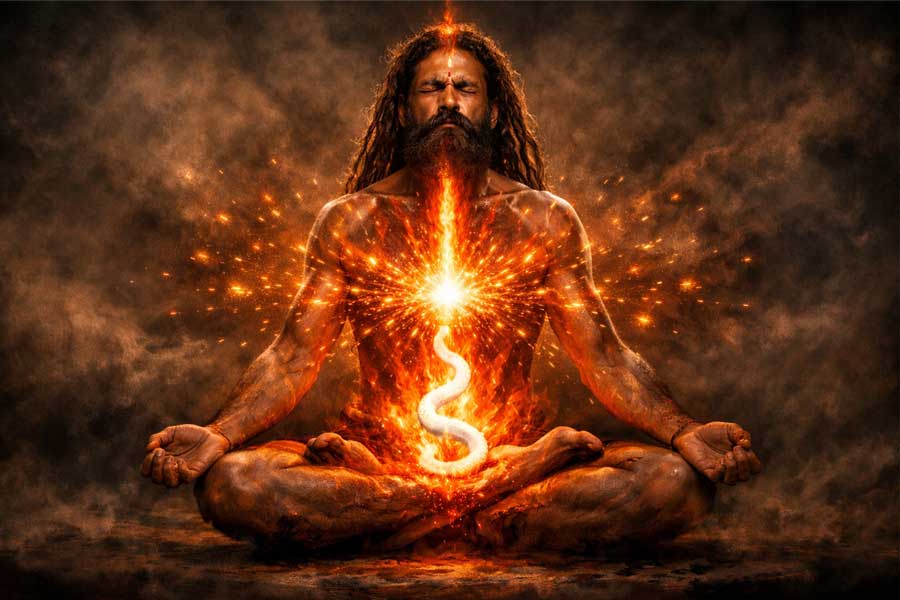
Just as a fire flares up when it is fanned, Bhastrika Pranayama ignites the inner fire of tapas generated through our practice. Bhastrika is one of the most beloved practices among yogis, as it gives rise to a subtle fire capable of transforming our nature.
This pranayama can open the Sushumna and activate the chakras. If there is stagnation in the body or the psyche, the practice of Bhastrika sets the energy into motion, allowing what has been troubling you to dissolve without a trace. Bhastrika can support the healing of the lungs and other organs of the respiratory system. Its fire is capable of burning away impurities accumulated in both body and mind, bringing the entire system into balance. The fire of tapas generated through Bhastrika can awaken Kundalini. Everything may be transformed—even the mind itself can be purified and refined under the influence of this pranayama. Bhastrika is included in many yogic systems of exercises and practices.
In the beginning, Bhastrika should be performed gently and with care, as excessive force may damage the delicate nasal tissues. Once the body is sufficiently warmed up, the intensity may be gradually increased. Alternatively, one may first warm up with other active practices and then perform Bhastrika more vigorously. In general, three levels of intensity can be distinguished—from very light and gentle to very intense and powerful.
At the initial stage, Bhastrika may be practiced for 2–5 minutes. Over time, the duration can be increased, but it is not recommended to exceed 20 minutes. Bhastrika generates heat, and the resulting energy may become excessively strong. As a result of practicing Bhastrika pranayama, sensory perception may become heightened—especially the sense of smell.
The technique of Bhastrika pranayama is simple: rapid inhalation and exhalation, similar to the action of a blacksmith’s bellows. Begin slowly, gently fanning the inner fire. Do not force the breath or practice with excessive intensity. When, during Bhastrika, both nostrils begin to flow evenly, this is a sign that the Sushumna—the central channel—has opened.
There are various forms of Bhastrika, depending on the intention of the practice. It may be combined with Ashwini Mudra, or practiced alternately through each nostril, as in Nadi Shodhana Pranayama. Bhastrika reduces the level of carbon dioxide in the blood and increases oxygenation. When there is sufficient oxygen, Kundalini awakens; carbon dioxide, on the other hand, acts upon the inner force much like a sedative. When Kundalini is awakened, strength of spirit and fearlessness arise, the chakras open, and love in the heart expands.