



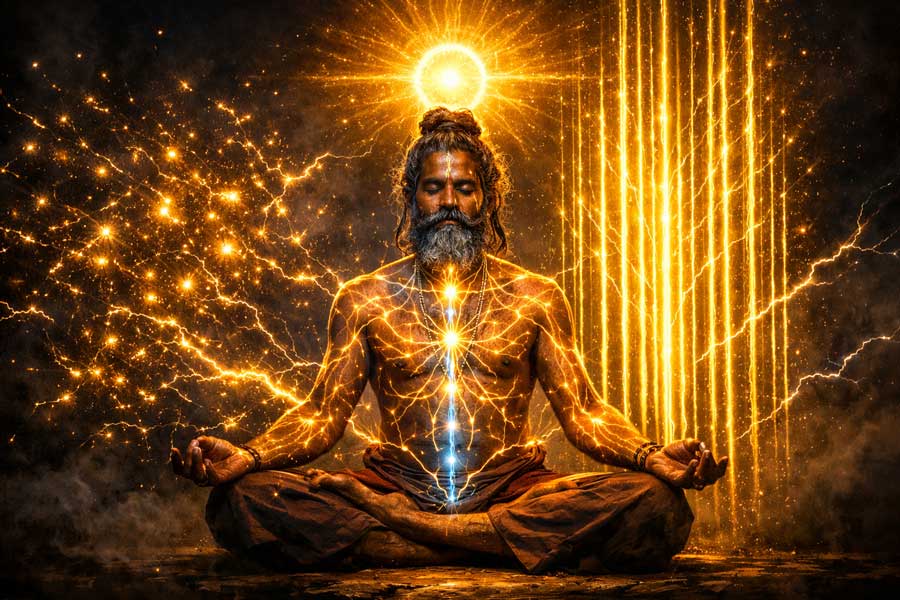
For a light bulb to shine, there must be an electric current in the conductor connected to it. From physics we know that electric current is the ordered movement of charged particles, and it arises only when electrons move in one direction. In a conductor without current, the directional vectors of the energies of charged particles are not aligned. Such chaotic movement of particles is known in physics as Brownian motion.
Therefore, without current the bulb does not shine, the engine does not run, and nothing works or even moves from its place. By analogy with a conductor, a person also cannot illuminate the “lamp” of their own nature and move forward if they do not organize and align their energies. This inability lies in the fact that the energies of an ordinary person resemble the chaotic motion of electrons in an uncharged conductor, where nothing truly happens.
At every moment, countless thoughts arise on the surface of our consciousness. An entire world exists within us, and in this world a constant play of elements unfolds. Pain and joy, victories and defeats, gains and losses are constant companions of the human being, shaking their entire nature. Thus, moving from one extreme to another, the mind forces its owner to circle endlessly. In the Bhagavad Gita it is said that the mind is both a friend and an enemy of a person. For one who has mastered the mind, it becomes the best of friends; for one who has lost control over it, the mind becomes the fiercest enemy. The power of the mind is immense. And if this power is not directed, not harmonized, not made unidirectional, a person will be unable to awaken the hidden sacred force within.
Shakyamuni Buddha once asked his disciple:
“Tell me, can a person be called a great warrior if he has defeated a thousand opponents in a thousand battles?”
“Yes, such a warrior may be called great,” the disciple replied.
To this the Buddha said:
“I tell you, the one who has conquered himself, who has subdued his own mind, is the greater warrior.”
Later, in the Dhammapada, Shakyamuni Buddha seems to echo these words:
“Noble Sindhi steeds, great elephants, obedient mules are good — but better than all of them is the one who has tamed himself. For with these animals one cannot reach the land that the self-tamed person reaches through practice and dispassion.”
Great power is hidden in control over the mind.
“For truly I say to you, if you have faith as a mustard seed, you will say to this mountain, ‘Move from here to there,’ and it will move; and nothing will be impossible for you,” proclaimed the Great Yogi of Nazareth.
The faith of which Jesus spoke is Sankalpa. Sankalpa is the power of thought — or rather, the power of directed thought — and it is also the power of will: unwavering will. Yogis discovered this force of Sankalpa long ago and developed it to perfection. This power can completely organize the particles of our inner “conductor” and make us divine.
Sankalpa is developed and strengthened through regular practice. Regularity is of key importance, and yogis pay special attention to it. Regularity is the necessary condition that brings order into our lives. When a rhythm is established, the energies of life, together with the substance of consciousness, become unidirectional — like a conductor through which electric current flows.
Breathing and mental processes are closely interconnected. What happens in a person’s inner world is reflected in their breathing: its frequency, depth, and rhythm. Imagine how a person breathes when they are angry, and how they breathe when they feel calm and pleasant. There is also a feedback loop between breathing and the mind. By controlling the breath, one can influence and regulate the processes of the inner world. This aspect of yoga is called pranayama. Through pranayama, one can align the inner energies and direct them toward the highest goal, ultimately making a transcendent leap into samadhi. Samadhi is the highest and final aim of yoga.
Regular practice creates an ordered, unidirectional movement of inner energies, and the flow of thoughts becomes structured. In this way, the mind can be fully brought under control. Then the mind and the power of thought become tools in our hands. And when this happens, Sankalpa — the power of intention — becomes extraordinarily powerful.