



Bhagavad Gita
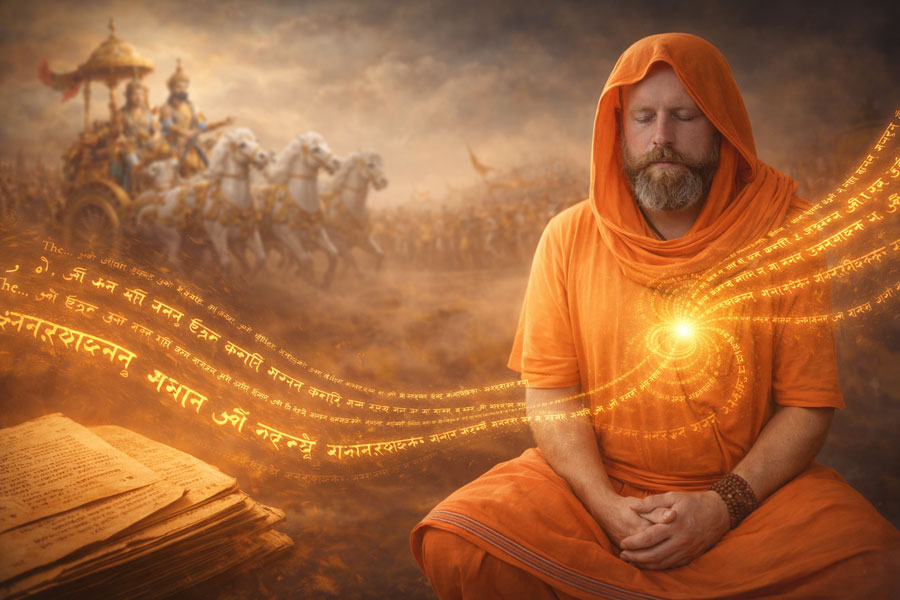
The Bhagavad Gita (The Song of Ishvara) is one of the most translated books in the world, available in over 80 languages. It is impossible to count the exact number of translations, as there are over 300 different versions in English alone. Each commentator or school seeks to provide its own interpretation, as Sanskrit is a multifaceted language where a single word can hold various meanings depending on the context and philosophical school. Thus, translators either strive for literalism (academic translations) or attempt to convey spiritual experience (yogic translations). The Gita is not a book; it is a conversation. and every conversation sounds different to each listener.
In Ukrainian, individual passages were translated as early as by Ivan Franko. Lesya Ukrainka also turned to Vedic texts and the Bhagavad Gita itself. However, the first complete translation from Sanskrit into Ukrainian was made by Mykola Ilnytskyi (published in the "Vsesvit" journal in the 1980s and later as a book. Ilnytskyi’s translation uses refined Ukrainian and poetic rhyme, though it contains some semantic inaccuracies.) There are also fragmentary translations by Pavlo Ritter. A modern translation by the Orientalist and Indologist Dmytro Burba was published in 2020. Additionally, there is a translation by Olesia Charivna (Gayatri), who worked with a team of philologists and editors to render this sacred text.
The translation of the Bhagavad Gita by Yogi Isha has its own unique characteristics. Yogi Isha is a disciple of an Immortal Himalayan Master, and through his Guru, he is connected to his parampara (lineage of teachers). Within this lineage are Teachers who took an active part in the events described in the Mahabharata (of which the Bhagavad Gita is a part). Some of these Teachers personally participated in the Battle of Kurukshetra and were directly acquainted with Lord Krishna. Thus, Yogi Isha's translation happened spontaneously; he himself did not fully understand how it occurred. He had attempted to translate the Gita long ago without success. But when the time came, a special energy opened the possibility for him to complete this work. His translation does not claim to be a linguistic masterpiece, nor does it need to be, for the most important thing is the spirit of the Gita. While translating, he felt that Krishna’s words were no different from what he heard from his Guruji. Thus, Yogi Isha simply recorded what he heard.
Author: Yogi Isha
The Shakti Orchestra music project manifested through Yogi Isha. It is Word and Sound unified in song to become a conduit for the Infinite.
The Path of Yogi IshaCreated with Love and Gratitude
to my Guru Pilot Babaji