



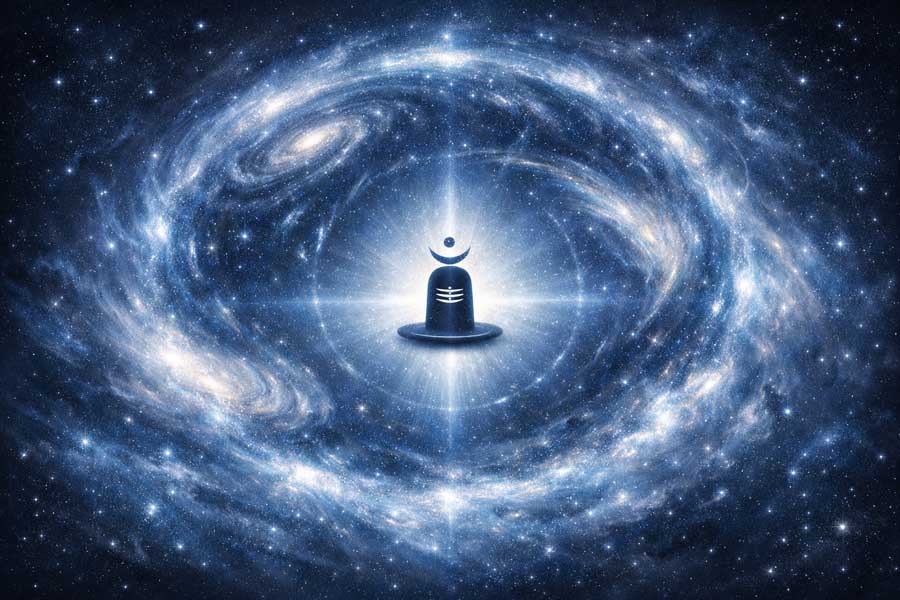
The Universe is an unlimited yet closed system. Let us assume that it is possible to imagine something beyond the Universe. This would imply the existence of another system, which is impossible, because the primary attributes of the Universe are its integrity and unity. The matter of our imagination is itself a component of the Universe. Everything that exists, and everything that can be imagined, is part of its cosmic matter. The Universe is a closed system with the boundaries of infinity. Everything that can be imagined must inevitably belong to it.
Thus, we have unlimited possibilities for imagination and unlimited freedom of choice, but also complete determinacy—it is impossible to imagine anything that is not part of this Universe, impossible to imagine something that does not exist. And everything we imagine, think, experience, or have the potential to do—always exists. Everything always is. We constantly generate new thoughts, yet in reality we create nothing. Everything already exists.
The matter of the Universe is in constant motion. That which does not move cannot be matter of the Universe. Motion is the very form of existence of matter. When motion diminishes, the system diminishes. That which does not move does not exist.
The fundamental property of motion is impermanence. Yet there must be “something” relative to which motion occurs. Motion is always relative. For example, we say a train moves at a speed of 100 kilometers per hour—but this speed is relative to stationary objects on Earth. Its speed relative to the Sun or another celestial body would be entirely different. We know that motion is the form of existence of matter—but relative to what does it occur? What is that absolutely motionless and unchanging reference point, relative to which everything that exists moves?
That which is absolutely motionless and unchanging is called Shiva.
Shiva is absolutely immutable and motionless, the center of the circle. It is the point at the center of the circle, without which the circle cannot exist. This point cannot have a radius. It is devoid of attributes and definitions. It seems to exist, yet at the same time it does not. For if it had even the tiniest radius, even an incomprehensibly small one, it would form another circle, which in turn would require a center—and so on, infinitely. There is the circle, and there is its center. There is nature, and its center—God. There is Shakti (the Energy of the Universe) and Her Shiva.
The interplay between Shiva and Shakti is the cause of the Universe’s existence. This relationship is symbolized in the Shivalingam. The Shivalingam models the cosmos, reflecting Shakti in the form of Yoni surrounding Shiva’s Lingam, just as a circle surrounds its center.
In relation to the manifested Cosmos, Shiva is the opposite pole of a magnet. He exists in absolute stillness. His stillness guarantees the existence of the world, for when He begins to dance, it brings universal dissolution. Then Shiva and Shakti become one. As long as they remain at opposite poles—like movement and absolute stillness—the manifested Cosmos continues to exist.