

1. How It All Began
It was an ordinary school biology lesson. Everything was as usual, nothing special, except for one detail: almost all the boys in my class were exploring the capabilities of their bodies — holding their breath for as long as they could and measuring the time with a stopwatch.
This idea did not come to their minds as a collective enlightenment; it was a planned initiative on my part. At that time, I had already been seriously involved in track and field at a sports school for two years and had practiced such exercises many times. My record at that time was 2 minutes and 30 seconds. For my classmates, these were astronomical figures, and this sparked their natural interest and excitement.
The biology teacher was not angry about our pranks but invited me to see him after the lesson. The subject of our conversation later became the central theme of my life. We were talking about yoga! Hryhoriy Maksymchuk said that I could practice yoga and improve myself in this way.
For the next lesson, he brought me a book in which the main pranayamas and some asanas were described in detail. Such books were very rare at that time, so I copied it by hand into a notebook. My first conscious steps into the world of yoga began with the pranayamas described in this book. But my practices started earlier. At the age of 12, I started running in a sports school. Training for middle- and long-distance running is good practice and real asceticism. At that time, I wanted to become a famous runner, although in reality, I was being propelled forward by forces that sought self-perfection.
2. An important event
The next important event worth mentioning took place in August 1989, when I had just turned sixteen. It seemed as if nothing had happened—and yet everything happened, and the river of my life overflowed its banks. Awareness always comes unexpectedly. It is impossible to prepare for it or to predict it. And just as a thread follows a needle, energy follows awareness—an energy that begins to transform life and magnetically attracts everything that is needed.
In my case, this awakening activated a latent, hidden memory of my past experience and my samskaras. I became a yogi who set out in search of God.
Two infinitely long years, filled with both pain and joy, had to pass before what was meant to happen finally happened. My burning mind was rewarded with freedom. Something within me suddenly stopped for a moment—unexpectedly and without warning—although in the days before, I had experienced such intense inner tension that it felt as if I might explode at any second. The best things that happen to us occur only when the mind no longer interferes.
Then another long year was needed for the waters of the river to merge with the boundless waters of the ocean—for the individual to dissolve into the infinite, for that which had taken form to return to its original source. No matter how long the path may be, it inevitably leads us to the goal—to the realization of that goal within ourselves.
My path was not an easy walk. Although formally I had no teacher, I always felt a connection with my Guru. I constantly sensed support and a flow of love from those I did not know, yet whose presence I always felt—those whom I inwardly called the Mahatmas. During that period, everything that happened along my path became my teacher.
3. Sport and education
On the second day after my first training session, I could barely get out of bed. At school, I had to walk down the stairs backward because my legs and abdominal muscles hurt so badly. Later it became easier, and I returned to training again. After a week, my body adapted, and I made a firm decision to become a serious runner.
What drove me to do this? I did not stand out for any exceptional natural physical abilities—quite the opposite. Among all the boys in my class, I held the honorable second-to-last place. Yet some inner impulse, which manifested itself as a clear and unwavering decision to become a professional runner, began to carve its path like an icebreaker. And soon, my determination and hard work bore fruit.
After three months of training, at the end of the school year, I took second place in my school in the 2-kilometer race within my age category and became a member of the school team. It is worth noting that I trained entirely on my own, drawing knowledge about proper training from a book by the Olympic champion Nikolay Ozolin, The Path to the Peak of Mastery. This continued for nine months. By then, I had already moved on to seventh grade, yet I never stopped training and even kept a detailed training diary—an idea I also learned from the book—in which I carefully recorded everything I did during my sessions. (Over seventeen years of training, I accumulated quite a number of such diaries.)
After nine months of independent training, while I was in seventh grade, I had my first meeting with my coach, Serhii Chaika. (Many years later, he would receive Diksha and the name Shiva Shankar.) erhiy became not only my coach but also my friend.
Sport soon took complete hold of me. I do not recall ever missing a training session. Less than a year later, while already in eighth grade, I became the regional champion and competed in the Ukrainian national championships. My main distances at that time were 400 and 800 meters. The following year, at the age of fifteen, I achieved the first adult sports rank in the 300-meter hurdles.
Throughout my athletic career, I competed at many different distances. However, during the last seven years of my running career, I specialized in marathon running, covering tens, hundreds, and thousands of kilometers in training. In 2001 alone, for example, I ran 7,000 kilometers. Marathon running is a serious test of both body and mind, and the training must be equally demanding. At times, I ran between 40 and 60 kilometers a day, and my weekly mileage often exceeded 200 kilometers. My highest weekly total reached 264 kilometers.
Such athletic asceticism is necessary for anyone who wishes to join the ranks of the world’s strongest runners. In my case, however, a different intention was at work, and I never became one of them. That intention directed my energies not outward, but inward—toward self-knowledge and self-realization. Long-distance running became for me a form of yogic practice, strengthening body and mind, transforming them into instruments of the spirit and an ideal field for cultivating willpower. Without engaging this inner force, yogic practices are no different from acrobatics or fitness. Any activity can become yoga if there is right concentration. A true yogi remains a yogi at all times, whether practicing or not. Yoga is a unidirectional flow of consciousness, and when concentration becomes absolute, the absence of practice (No-practice) becomes the highest practice.
Interestingly, my first formal education was not related to sport. I even graduated with honors, although I never worked in that specialty. Later, however, I earned a master’s degree in physical education and sport, writing both my bachelor’s and master’s theses on yoga. An offer to continue my studies in graduate school and to teach yoga at a university did not resonate with me. I wanted to remain a free yogi. For that reason, working as a track-and-field coach—bureaucratic aspects aside—proved to be the most suitable path for me. Overall, I have more than twenty years of experience coaching both teenage and adult athletes.
The sporting chapter of my life, which lasted nearly thirty years, has now been closed. Sport gave me an invaluable store of practical and theoretical experience. It was a profound ascetic discipline. Not a single kilometer of training was wasted—everything remains within me, like funds carefully placed in a long-term deposit.
4. Become Yogi Isha
Between words in a sentence, there is a gap.
Between two consecutive sounds, there is a gap.
Between everything that exists, there are gaps.
There is a gap between the Guru and the disciple.
A disciple may be infinitely devoted to the Guru, and this is a beautiful relationship.
Yet the disciple can enter the gap between himself and the Guru.
In this gap, there is neither Guru nor disciple — only Truth itself.
Is a Guru necessary? Yes.
A Guru is needed so that there may be two — and the gap between them.
A person walks a long path through life. Different life circumstances sometimes slow the movement forward, sometimes accelerate it, and often it seems as though one is moving in circles. It is a great blessing to meet a Guru on one’s path. A true Guru is not merely a spiritual teacher who offers knowledge and instruction; a true Guru is an inseparable part of ourselves, in whose presence our own nature is revealed.
There are no linguistic or spatial barriers in the relationship between disciple and Guru. What is most important in this relationship always happens without words. The most precious gifts of the Guru lie beyond the domain of the mind. Therefore, the best thing one can do in the presence of the Guru is to enter into resonance with him—to become receptive to his flow—and everything that is needed will unfold by itself.
It does not matter when the first formal meeting with the Guru takes place; time has no significance in this relationship. The disciple–Guru relationship exists beyond mind, beyond time and space. And when something truly happens, you begin to realize that you have never met the Guru, because you were never separated. He is you yourself.
There are two and a gap between them. When one enters that gap, the two become one. Then once again there are two and the gap between them. This is how the play called lila unfolds.
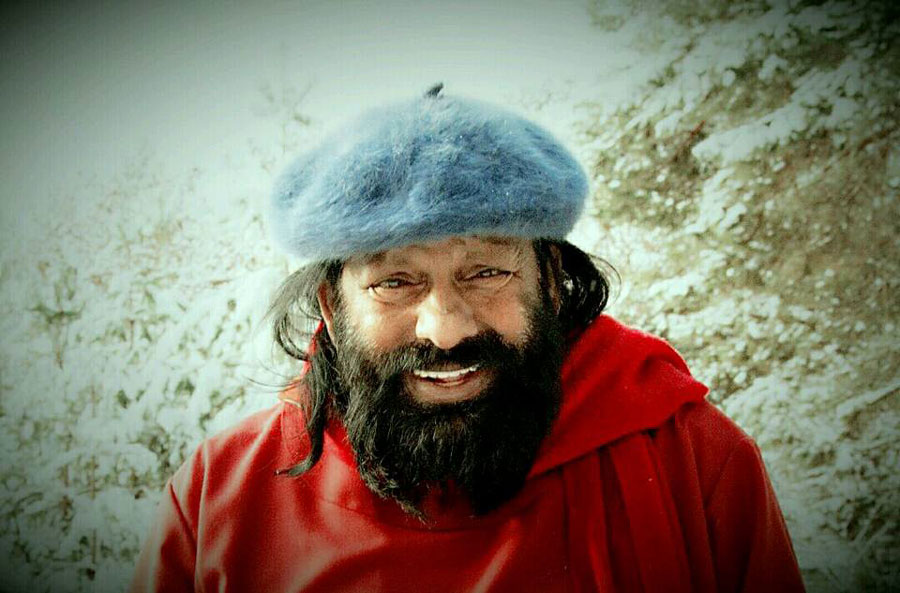
I did not meet my Master in India, although he is Indian. My Guru, Pilot Baba, constantly travels the world, speaking to people about yoga and helping them on their spiritual path. During one of his visits to Ukraine, I received Guru Diksha from my Baba and was given the name Yogi Isha.
5. It All Depends Only on Us
My body is the house in which my mind lives.
My mind is the house in which my essence lives.
When I look at the starry sky, the Earth is like a small insect in the vast Cosmos. And when I look within myself, the Cosmos, like a little fish that has dived into the ocean, disappears into the Great Emptiness.
”Samadhi exists constantly, regardless of whether anyone enters it or leaves it.
No one teaches anyone. Everyone learns by themselves. We can only share our own experience and speak about our path. Knowledge may come from anywhere, but the ability to assimilate knowledge comes from within, and whether we use it or not depends only on us.
The practice of yoga can completely heal the body, strengthen the mind, and make life happy, but for this to happen, intention is required. One must have an open heart; one must have love. And if there is concentration, if there is intention, then everything becomes possible. True intention opens the door to samadhi. True intention leads us to the Truth and to God.